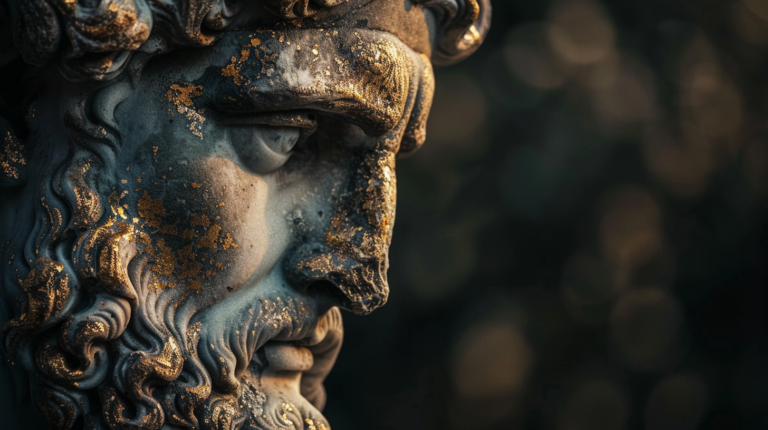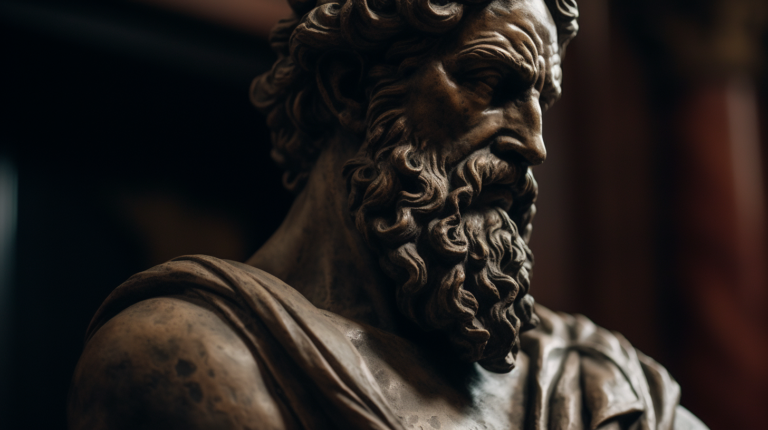
Socrates (c. 470–399 BC) is arguably the most influential philosopher who ever lived. He’s the figure that almost every branch of Western philosophy traces itself back to, and his ideas on wisdom, virtue, and the examined life have shaped how we think about what it means to live well for over two thousand years.
What makes Socrates unique among the great philosophers is that he never wrote a single word down. Everything we know about his teachings comes from the people around him, primarily his student Plato, but also the historian Xenophon, and later writers like Diogenes Laertius and Plutarch. Each of them captured a slightly different side of Socrates: Plato gives us the sharp thinker; Xenophon gives us the practical, down-to-earth teacher; and Diogenes Laertius gives us the witty character who wandered the markets of Athens questioning everything.
His method of teaching, now known as the Socratic method, didn’t involve lecturing or handing down answers. Instead, he asked questions. Relentlessly. He would probe a person’s assumptions until they either arrived at a deeper truth or realised they didn’t know as much as they thought they did. It’s a method still used in law schools and philosophy classrooms today, and it comes from the same core belief that Epictetus would later build on: that real knowledge begins with recognising your own ignorance.
Socrates was eventually sentenced to death by the Athenian court on charges of corrupting the youth and impiety. Rather than flee, which he could have done, he accepted the verdict and drank the hemlock, staying true to his principles to the very end. His death is one of the most powerful moments in the history of philosophy, and it cemented his legacy as someone who didn’t just talk about virtue but lived it.
Below are some of his greatest quotes, drawn from the works of those who knew him and wrote about him.
Socrates’ Greatest Quotes:
From Plato’s Dialogues
- “It would be better for me that multitudes of men should disagree with me rather than that I, being one, should be out of harmony with myself.” – Gorgias
- “In every one of us there are two ruling and directing principles, whose guidance we follow wherever they may lead; the one being an innate desire of pleasure; the other, an acquired judgment which aspires after excellence.” – Phaedrus
- “Oh dear Pan and all the other gods of this place, grant that I may be beautiful inside. Let all my external possessions be in friendly harmony with what is within. May I consider the wise man rich. As for gold, let me have as much as a moderate man could bear and carry with him.” – Phaedrus
- “One should never do wrong in return, nor mistreat any man, no matter how one has been mistreated by him.” – Crito
- “Has a philosopher like you failed to discover that our country is more to be valued and higher and holier far than mother or father or any ancestor, and more to be regarded in the eyes of the gods and of men of understanding?” – Crito
- “I only wish that wisdom were the kind of thing that flowed from the vessel that was full to the one that was empty.” – Symposium
- “Anyone who holds a true opinion without understanding is like a blind man on the right road.” – Republic
- “Each of these private teachers who work for pay inculcates nothing else than these opinions of the multitude which they opine when they are assembled and calls this knowledge wisdom.” – Republic
- “The inexperienced in wisdom and virtue, ever occupied with feasting and such, are carried downward, and there, as is fitting, they wander their whole life long, neither ever looking upward to the truth above them nor rising toward it, nor tasting pure and lasting pleasures.” – Republic
- “If the entire soul follows without rebellion the part which loves wisdom, the result is that in general each part can carry out its own function, can be just, in other words, and in particular each is able to enjoy pleasures which are its own, the best, and, as far as possible, the truest.” – Republic
From Xenophon’s Memorabilia
- “It is a disgrace to grow old through sheer carelessness before seeing what manner of man you may become by developing your bodily strength and beauty to their highest limit. But you cannot see that, if you are careless; for it will not come of its own accord.” – Memorabilia
- “You will know that the divine is so great and of such a nature that it sees and hears everything at once, is present everywhere, and is concerned with everything.” – Memorabilia
- “The being of all virtues, and chiefly of temperance, depends on the practice of them.” – Memorabilia
- “Does teaching consist in putting questions? Indeed, the secret of your system has just this instant dawned upon me. I seem to see the principle in which you put your questions. You lead me through the field of my own knowledge, and then by pointing out analogies to what I know, persuade me that I really know some things which hitherto, as I believed, I had no knowledge of.” – Oeconomicus
- “If I am to live longer, perhaps I must live out my old age, seeing and hearing less, understanding worse, coming to learn with more difficulty and to be more forgetful, and growing worse than those to whom I was once superior.” – Memorabilia
From Diogenes Laertius
- “I know nothing except the fact of my ignorance.”
- “How many things I have no need of!”
- “There is only one good, knowledge, and one evil, ignorance.”
- “Those who want fewest things are nearest to the gods.”
- “The rest of the world lived to eat, while he himself ate to live.”
From Plutarch
- “I am not an Athenian or a Greek, but a citizen of the world.”
- “Bad men live that they may eat and drink, whereas good men eat and drink that they may live.”
On Self-Mastery
One of Socrates’ most consistent themes is the idea that mastering yourself is the foundation of a good life. This is a thread that runs through Stoicism, Buddhism, and many of the traditions we cover here at Orion Philosophy. Where Marcus Aurelius would later write about ruling your own mind, and Lao Tzu would speak of mastering yourself as true power, Socrates was laying that same groundwork centuries earlier.
His prayer from the Phaedrus, asking to be beautiful inside rather than wealthy on the outside, is one of the most quietly powerful passages in all of philosophy. It’s a reminder that the things we chase externally are often distractions from the internal work that actually matters.
On Ignorance and Wisdom
Socrates’ most famous idea, that true wisdom begins with knowing that you know nothing, isn’t false modesty. It’s a method. By starting from a position of not-knowing, you open yourself up to genuine inquiry rather than defending positions you’ve already committed to. It’s the same principle behind the Zen concept of beginner’s mind, and it’s why Socrates’ approach still feels relevant thousands of years later.
His line about the blind man on the right road captures this perfectly. You can hold the correct opinion about something without truly understanding why it’s correct, and that’s a fragile kind of knowledge. Real wisdom comes from understanding, not just from being right.
Socrates never wrote a book, never built a school, and never held political power. Yet his influence runs through virtually every philosophical tradition that followed him. The Stoics drew heavily from his emphasis on virtue and self-knowledge. Plato built an entire philosophical system from his teachings. And Aristotle, who studied under Plato, carried Socratic ideas forward into ethics, logic, and science.
What makes Socrates’ quotes endure isn’t their complexity, it’s their simplicity. “How many things I have no need of” is something you could think about every time you scroll through an online shop. “One should never do wrong in return” is a principle that could reshape how you handle conflict today.
That’s the power of Socrates. The questions he asked in the streets of Athens are still worth asking now.